
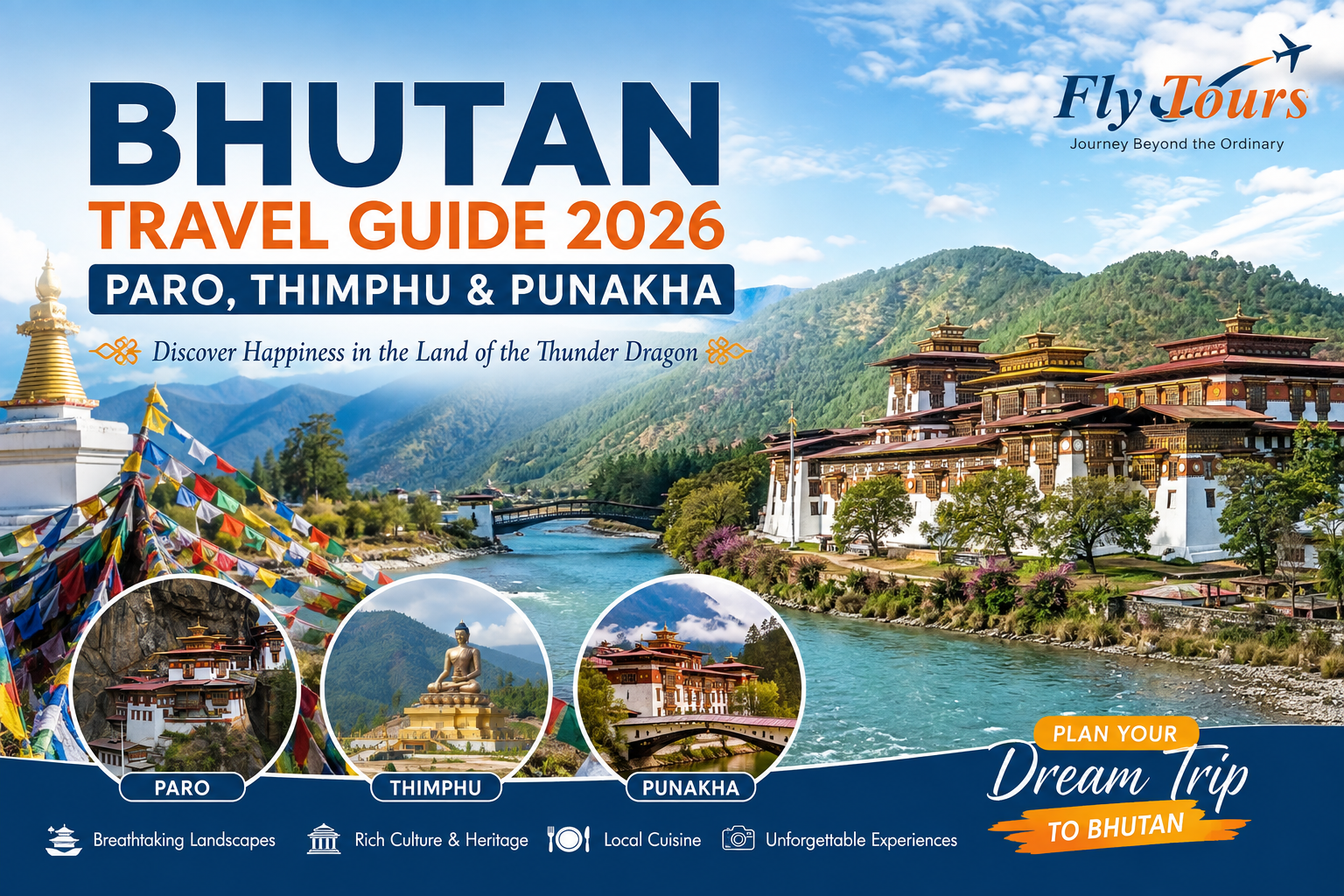
Bhutan measures national progress in Gross National Happiness rather than GDP, and it takes only a few days in the country to understand why that framing has stuck. This is a kingdom that has deliberately kept tourism small and controlled, capped forest cover written into its constitution, and a capital city, Thimphu, that remains the only one in the world without a single traffic light. For Indian travellers, it is also refreshingly accessible: no visa is required, flights land directly into Paro, and a well-organised six-day circuit is enough to cover the country's three most-visited valleys properly.
What makes Bhutan different from most international trips is that independent travel simply is not an option here. Every visitor, regardless of nationality, must travel with a licensed local guide and a pre-arranged itinerary, and permit paperwork has to be sorted before you land. This guide walks through everything a first-time visitor needs to know: the visa and permit situation for Indians, what the Sustainable Development Fee actually is, a full breakdown of the standard Paro-Thimphu-Punakha itinerary, and how to pick the right package for the kind of trip you want.
Do Indians Need a Visa for Bhutan?
This is usually the first question, and the answer is genuinely simple: no. Indian citizens do not need a visa to enter Bhutan. A valid Indian passport with at least six months of remaining validity, or a Voter ID card, is sufficient to obtain an entry permit on arrival. This is one of the biggest reasons a Bhutan tour has become such a popular short international trip from India, since the paperwork burden that usually accompanies international travel is largely absent here.
What Indian travellers do need to budget for is the Sustainable Development Fee, commonly abbreviated as the SDF, which is Bhutan's mechanism for managing tourist volume and funding public programs, rather than a visa fee in the conventional sense. For anyone planning a Bhutan tour, understanding the SDF in advance can help with accurate trip budgeting and smoother travel planning.
Understanding the Sustainable Development Fee (SDF)
Bhutan charges every tourist a Sustainable Development Fee, and the amount depends significantly on nationality. Most international visitors pay USD 100 per night, but Indian nationals pay a considerably lower rate of ₹1,200 per person, per night. This fee is separate from your land package cost and is typically paid at the permit stage rather than bundled into the tour price upfront.
The SDF is not simply a tourism tax in the way many countries charge one; Bhutan directs this revenue toward free healthcare, free education, and conservation programs across the country. It is worth factoring this into your total trip budget early, since a 5-night stay adds a predictable, fixed cost on top of whichever land package you choose.
Why You Cannot Travel Bhutan Independently
Unlike most international destinations, Bhutan does not permit fully independent tourism. Every visitor is required to travel with a licensed Bhutanese guide and a private vehicle, arranged in advance as part of a structured itinerary, and this applies whether you are travelling solo, as a couple, or in a large group. For many first-time visitors, this initially sounds restrictive, but in practice it removes almost all of the logistical friction that international travel usually involves: navigating local transport, language barriers, and independently sourcing reliable information about opening hours or trail conditions simply are not concerns here, since your guide manages all of it.
This structure is also precisely why booking through an established operator matters in Bhutan more than it might elsewhere. The entry permit itself has to be processed before or upon arrival, and a good operator, like Fly Tours, folds this paperwork directly into the standard booking process rather than leaving travellers to coordinate it themselves.
The Three Valleys: Paro, Thimphu & Punakha
A standard Bhutan circuit covers three distinct valleys, each with a genuinely different character.
Paro
Paro is where nearly every visitor's Bhutan trip begins and ends, since Paro International Airport is the country's only entry point by air, and the landing itself, weaving between mountain ridges, is often described as one of the most scenic commercial landings in the world. Paro is also home to the trip's single most iconic site: Taktsang Monastery, universally known as Tiger's Nest, which clings to a cliff face roughly 900 metres above the valley floor.
Thimphu
Bhutan's capital and largest city, yet remarkably low-key by capital-city standards, with no traffic lights and a skyline dominated by traditional Bhutanese architecture rather than glass towers. Thimphu is home to the Buddha Dordenma, a massive bronze Buddha statue overlooking the valley, along with Tashichho Dzong, the Memorial Chorten, and the Folk Heritage Museum.
Punakha
A lower-altitude valley reached via the dramatic Dochula Pass, home to Punakha Dzong, a fortress-palace set at the confluence of the Pho Chhu and Mo Chhu rivers and widely regarded as the most photogenic dzong in the country. The drive to Punakha also passes Chimi Lhakhang, a smaller but culturally significant temple along the route.
The Complete 6-Day Itinerary
Day 1: Arrival in Paro
Flights land into Paro, followed by a roughly 1.5-hour transfer to Thimphu, with the evening typically left at leisure to settle in after the flight.
Day 2: Thimphu Sightseeing
A full day covering the Buddha Dordenma statue, Tashichho Dzong, the Memorial Chorten, and the Folk Heritage Museum.
Day 3: Thimphu to Punakha
The drive to Punakha crosses Dochula Pass, a scenic stop with mountain views and 108 memorial chortens, before continuing on to Punakha Dzong and Chimi Lhakhang temple.
Day 4: Punakha to Paro
A return drive to Paro, with the afternoon left free or spent visiting the National Museum and Rinpung Dzong.
Day 5: Tiger's Nest Hike
The trip's centrepiece: a full-day hike, or partial pony ride, up to Taktsang Monastery, widely considered the highlight of any Bhutan trip.
Day 6: Departure
A transfer to Paro International Airport for the onward flight home.
What's Included in a Standard Package
• 5 nights of hotel accommodation (3-star, twin-sharing) across Paro, Thimphu, and Punakha
• Daily breakfast, lunch, and dinner
• Licensed Bhutanese tour guide and private vehicle, mandatory for all tourists
• Entry permit processing
• All applicable taxes
Excluded from the standard package are airfare to and from Paro, which can only be flown on Drukair or Bhutan Airlines, the two carriers permitted to operate flights into the country, along with the Sustainable Development Fee itself, personal expenses, tips for the guide and driver, and travel insurance.
The Tiger's Nest Hike: What to Actually Expect
Taktsang Monastery, or Tiger's Nest, is the single most anticipated part of most Bhutan itineraries, and for good reason: few sights anywhere combine this level of dramatic setting with genuine spiritual significance. The hike itself runs roughly 4 to 5 hours round trip, climbing steadily along a forested trail with the monastery visible, seemingly impossibly perched, for much of the ascent. A pony ride is available for part of the climb for travellers who want to reduce the physical demand, and for those unable or unwilling to hike at all, a viewpoint café partway up the trail offers essentially the same iconic view of the monastery without completing the full ascent.
This flexibility matters, since it means the Tiger's Nest experience can be adapted across very different fitness levels without anyone missing the trip's signature moment entirely.
Best Time to Visit Bhutan
March to May, Bhutan's spring season, brings blooming rhododendrons and clear valley views, making it one of the two peak windows for visiting. September to November, autumn, offers crisp air, some of the year's best mountain visibility, and coincides with Bhutan's biggest festivals, known as tshechus, colourful masked-dance celebrations held at monasteries and dzongs across the country.
June to August brings monsoon rain, which can affect visibility and road conditions, while December to February is cold with possible snow at higher elevations, a quieter, lower-tourist window for travellers who don't mind the chill and want a more solitary experience of the valleys.
Choosing the Right Package for Your Trip
Honeymoon Package (₹13,999/person)
Pairs the Tiger's Nest hike with a slower, more romantic stop at Punakha Dzong, and rounds out the middle days with Thimphu's Buddha Dordenma statue and evening market. Boutique mountain-view accommodation is booked wherever available, and the pace stays deliberately gentle throughout, one significant activity a day, in keeping with Bhutan's own unhurried rhythm.
Family Package (₹10,999/person)
Leans into easy, engaging stops for children, Thimphu's Takin Preserve and the Buddha Dordenma statue, while offering flexibility on the Tiger's Nest hike, families can hike partway with a pony option or view the monastery from the base café instead. Punakha Dzong's riverside setting makes for a relaxed final major stop.
Senior Citizen Package (₹12,499/person)
Treats the Tiger's Nest hike as entirely optional, offering a relaxed viewpoint café visit with the same iconic view instead. Ground-floor or lift-accessible rooms are requested at every hotel, each day is limited to a single major activity with a genuine rest window, and a private vehicle handles every transfer between valleys.
Budget / Group Package (₹8,499/person)
A trimmed five-day version using standard hotels instead of boutique properties and a shared vehicle for groups of six or more, while keeping Tiger's Nest, the Buddha Dordenma, and Punakha Dzong all fully on the itinerary. The Sustainable Development Fee remains a separate, fixed charge regardless of package tier.
Luxury Package (₹24,999/person)
Uses premium mountain-view resorts across all three valleys, several offering traditional Bhutanese hot stone baths, with a private guide and vehicle for the full trip. The Tiger's Nest hike includes a private packed breakfast at the halfway café, and dining is curated around authentic Bhutanese dishes like ema datshi, red rice, and momos rather than a generic hotel buffet.
Solo Traveller Package (₹11,499/person)
Books single occupancy rooms across all three towns and assigns a dedicated guide who typically becomes your main companion for the trip, a structure that many solo travellers find makes Bhutan one of the more socially comfortable solo destinations available, precisely because a guide accompanies you throughout by default.
Practical Tips for First-Time Visitors
• Carry a valid Indian passport with at least six months of validity, or a Voter ID card, since either is sufficient for entry without a visa.
• Budget separately for the Sustainable Development Fee at ₹1,200 per person per night, since this is not included in any land package price.
• Book flights on Drukair or Bhutan Airlines specifically, as these are the only two carriers permitted to fly into Paro.
• Pack layered clothing and sturdy footwear for the Tiger's Nest hike, along with sun protection, since much of the trail is exposed.
• Carry small denominations of cash for local markets and smaller vendors, since card acceptance can be inconsistent outside main hotels.
• Respect dzong and monastery dress codes, generally modest clothing covering shoulders and knees, particularly during active religious ceremonies.
Money, Connectivity, and Everyday Practicalities
Bhutan's currency, the Ngultrum, is pegged one-to-one with the Indian Rupee, and Indian Rupees are widely accepted throughout the country, which removes one more layer of friction for Indian travellers compared to almost any other international destination. That said, carrying some Ngultrum or smaller Rupee denominations for local markets, tea stalls, and smaller vendors is still useful, since large notes are not always easy to break in more remote areas.
Mobile connectivity has improved considerably in recent years, with reasonably reliable coverage in Paro, Thimphu, and Punakha town centres, though it can thin out along mountain passes like Dochula. Most hotels offer WiFi, and a local SIM card is easy to arrange through your guide on arrival if you need continuous connectivity throughout the trip. Bhutan's use of the Indian Rupee alongside its own currency, combined with widespread basic English proficiency among guides and hotel staff, makes day-to-day navigation considerably more straightforward than many first-time visitors expect from an international Himalayan trip.
Food and Culture: What to Expect
Bhutanese cuisine centres around a few distinctive staples: red rice, a slightly nutty short-grain variety grown at altitude, and ema datshi, a fiery dish of chillies stewed with local cheese that appears in some form at nearly every meal. Momos, Bhutan's version of dumplings, are widely available and often filled with cheese, vegetables, or meat. Most standard packages serve a mix of Bhutanese and Indian or continental dishes at hotels, while luxury packages tend to lean further into authentic, curated Bhutanese dining experiences.
Culturally, Bhutan remains a deeply Buddhist kingdom, and this shows in daily life far beyond its monasteries and dzongs, prayer flags strung across mountain passes, prayer wheels spun by passersby, and a generally unhurried, courteous pace to public life. Photography inside monasteries and dzongs is often restricted, particularly in inner sanctums, so it's worth checking with your guide at each site rather than assuming it is allowed everywhere.
Frequently Asked Questions
Do I need any vaccinations to visit Bhutan?
Bhutan does not currently mandate specific vaccinations for Indian travellers, though it is always sensible to check current health advisories closer to your travel date and consult a doctor if you have specific health concerns given the altitude involved in parts of the itinerary.
How difficult is the Tiger's Nest hike for someone with average fitness?
Most travellers with reasonably average fitness complete the hike in the standard 4 to 5 hours round trip, though the trail is steep in sections. The availability of a partial pony ride and the base viewpoint café option means the experience can be adjusted for a wide range of fitness levels.
Can this itinerary be extended beyond 6 days?
Yes, most operators, including Fly Tours, offer customizable itineraries, and travellers wanting to add destinations like Bumthang or extend time in any of the three core valleys can typically do so with advance planning.
Is Bhutan expensive to visit compared to other international trips?
For Indian travellers specifically, Bhutan is considerably more affordable than it is for other nationalities, thanks to the discounted Sustainable Development Fee and the absence of visa costs. Once the SDF and land package are factored in together, it remains a competitively priced international trip from India.
What is the best way to book flights to Paro?
Flights into Paro can only be booked on Drukair or Bhutan Airlines, since these are the only two carriers permitted to operate into the country. It's worth booking these early, particularly during the peak spring and autumn seasons, since seat availability is limited.
Conclusion
Bhutan offers a genuinely different kind of international trip: no visa hassle for Indian travellers, a mandatory but refreshingly stress-free guided structure, and three valleys, Paro, Thimphu, and Punakha, that between them cover dramatic monastery hikes, capital-city culture, and riverside fortress architecture in a single well-paced six-day circuit. The Sustainable Development Fee and guide requirement are simply part of how the kingdom manages tourism responsibly, and once factored into your budget and expectations upfront, they add very little friction to planning the trip.
With land packages starting at ₹8,499 per person and six distinct variants built around honeymooners, families, seniors, groups, luxury travellers, and solo explorers, Fly Tours structures this Bhutan travel guide's itinerary around how you actually want to experience the kingdom, permit paperwork, guide arrangement, and Sustainable Development Fee processing included. If Tiger's Nest and Bhutan's unhurried, happiness-focused pace have been on your travel list, this six-day circuit remains one of the most accessible international trips available from India.
Comments (0)
Leave a Comment