
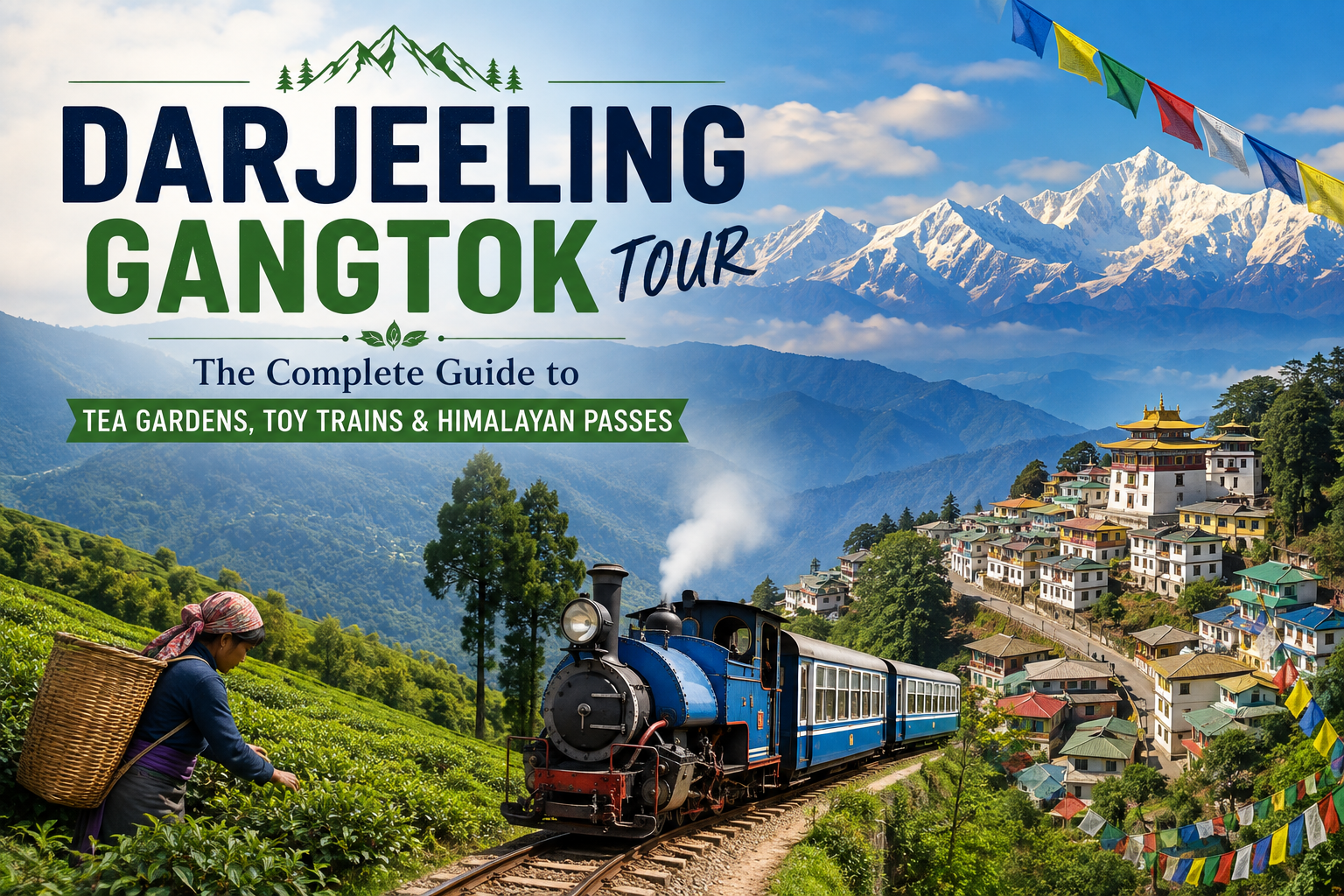
Some hill-station trips blur into one another after a while, but a well-planned Darjeeling Gangtok tour rarely does, mostly because the two towns could not feel more different from each other. Darjeeling moves at the unhurried pace of its century-old toy train, tea gardens rolling past the window and Kanchenjunga occasionally breaking through the clouds at sunrise. Cross the border into Sikkim, and Gangtok picks up the tempo almost immediately: prayer flags strung across monastery courtyards, a café-lined MG Marg that closes to traffic every evening, and the genuine high-altitude drama of Tsomgo Lake and Nathula Pass a few hours further up.
Because this itinerary crosses from West Bengal into Sikkim and touches a restricted international border at Nathula Pass, it also comes with more paperwork than a typical hill-station trip, which is exactly why most travellers book it as a package rather than piecing it together independently. This guide walks through what a complete Darjeeling Gangtok tour actually involves, day by day, what it costs, which travellers each version of the trip suits best, and what to know about permits and timing before you book.
Why Darjeeling and Gangtok Work So Well Together
Darjeeling and Gangtok sit close enough geographically, roughly four to five hours apart by road, that pairing them into a single circuit makes obvious logistical sense. But the real reason this combination has become one of Eastern India's most popular hill circuits is contrast. Darjeeling's identity is built around colonial-era hill station charm: the UNESCO-listed Darjeeling Himalayan Railway, working tea estates that have been in continuous operation for well over a century, and the ritual of a pre-dawn drive up to Tiger Hill for a shot at seeing Kanchenjunga, the world's third-highest peak, catch the first light.
Gangtok, by contrast, feels distinctly Sikkimese: Buddhist monasteries with genuine religious significance rather than purely historical ones, a modern pedestrian-only high street in MG Marg, and access to some of the most dramatic high-altitude landscape in the country at Tsomgo Lake, sitting at 3,780 metres, and Nathula Pass, the actual trading post on the India-China border. Travelling both in one trip means experiencing two very different registers of the Eastern Himalayas without the logistics of arranging separate journeys.
The Complete 6-Day Itinerary
A standard Darjeeling Gangtok tour runs across 6 days and 5 nights, structured to give each destination enough time without feeling rushed, while building in the permit-dependent flexibility that a Nathula Pass visit requires.
Day 1: Arrival in Darjeeling
The trip begins with a transfer from Bagdogra Airport or New Jalpaiguri (NJP) railway station up to Darjeeling, a scenic drive that gains altitude steadily as the plains give way to hills. Most itineraries keep the evening free, giving travellers a chance to explore Mall Road and Chowrasta at their own pace before the more structured sightseeing begins the next day.
Day 2: Darjeeling Sightseeing
This is the fullest day of the Darjeeling leg. It typically starts before sunrise with the drive up to Tiger Hill, timed for the first light on Kanchenjunga, weather and visibility permitting, since cloud cover is common enough that this view is never fully guaranteed. The day continues with a stop at Batasia Loop, a joy ride on the Darjeeling Himalayan Railway toy train, usually along the short Darjeeling-to-Ghum stretch, a visit to a working tea garden with a tasting session, and a stop at the Peace Pagoda.
Day 3: Darjeeling to Gangtok
The circuit shifts into Sikkim with a drive to Gangtok, generally taking four to five hours depending on road conditions. Evenings here are typically left open for a stroll along MG Marg, Gangtok's pedestrian-only main street lined with cafés and shops, a genuinely pleasant way to ease into the town's different pace.
Day 4: Tsomgo Lake and Nathula Pass
This is the highlight day for most travellers, and also the one most dependent on permits and weather. The full-day excursion covers Tsomgo (Changu) Lake, Baba Mandir, and, permit and road conditions allowing, Nathula Pass itself on the India-China border. It's worth noting this excursion typically does not run on Mondays and Tuesdays, so itinerary planning needs to account for that closure.
Day 5: Gangtok Local Sightseeing
A gentler day covering Rumtek Monastery, one of Sikkim's most significant Buddhist monasteries, along with Ganesh Tok, Hanuman Tok, and the Sikkim Zoological Park.
Day 6: Departure
The trip closes with a transfer back to Bagdogra or NJP for onward travel.
What a Standard Package Includes
• 5 nights of hotel accommodation on double-sharing across Darjeeling and Gangtok
• Daily breakfast and dinner (MAP meal plan)
• All transfers and sightseeing by private vehicle
• Toy train joy ride ticket
• Tsomgo Lake and Nathula Pass permit assistance and processing
• All applicable taxes
Airfare or train fare to Bagdogra or NJP is not included, nor is the Nathula Pass permit's government fee (roughly ₹200 per person, paid directly at the counter) or Tsomgo Lake entry. Lunch is generally excluded unless specified, along with personal expenses and travel insurance.
Understanding the Nathula Pass Permit
Nathula Pass sits on a genuinely restricted international border, and this is the one part of a Darjeeling Gangtok tour that cannot be arranged casually. Indian citizens need a Protected Area Permit, which can only be arranged through registered tour operators, requires a valid photo ID and passport-sized photographs submitted at least a day in advance, and is subject to weather and road clearance on the day itself. Foreign nationals face a separate, generally more restrictive permit process.
Beyond Nathula specifically, entering Sikkim itself requires an Inner Line Permit for Indian citizens, arranged as a standard part of any properly organised itinerary. Because both permits depend on paperwork, timing, and sometimes weather-related road closures, this is precisely the kind of logistics where booking through an operator who handles the applications, rather than attempting it independently, saves genuine stress partway through the trip.
Best Time to Visit
Timing has a real effect on how much of this itinerary you actually get to experience, particularly the Nathula Pass leg. March to June and September through mid-December generally offer the clearest mountain views and the most comfortable temperatures, and this window also tends to be when Nathula Pass is most reliably open, since it typically closes for winter snow from December onward.
Monsoon season, roughly June through September, brings heavy rain and a real landslide risk on hill roads, and is generally not recommended for this circuit. Winter, December through February, is cold but scenic, with a genuine chance of snow in Gangtok, though Nathula access becomes unpredictable during this period and should not be counted on.
Choosing the Right Package for Your Trip
A Darjeeling Gangtok tour is rarely one-size-fits-all, and the right version of this itinerary depends heavily on who is travelling and what they want out of it.
Honeymoon Package (from ₹21,499/person)
Built around shared, quieter moments: the Tiger Hill sunrise, a scenic toy train ride, tea garden walks, and an evening stroll along MG Marg. Hotel rooms are booked with mountain or valley views wherever available, since that outlook is a large part of the appeal for couples on this circuit.
Family Package (from ₹18,999/person)
Keeps tea garden walks short and flat rather than longer plantation treks, and leans into what genuinely excites both kids and grandparents, the toy train ride and a yak ride along Tsomgo Lake's shoreline during winter months. Connecting rooms are arranged wherever hotel inventory allows, and the pre-dawn Tiger Hill excursion is kept optional for families who would rather sleep in.
Senior Citizen Package (from ₹20,499/person)
Specifically accounts for the altitude jump to Tsomgo Lake's 3,780 metres from Darjeeling's roughly 2,050 metres. Ground-floor or lift-accessible rooms are requested at every hotel, the vehicle used for the Gangtok-Tsomgo Lake stretch carries oxygen support as standard, and enough buffer time is built in between legs that the altitude change doesn't feel abrupt.
Budget / Group Package (from ₹13,499/person)
A five-day version that keeps the toy train, tea garden visit, and Tsomgo Lake excursion firmly in place while trimming the hotel category to a solid 3-star and moving transport to a shared Tempo Traveller for groups of six or more. Tiger Hill's sunrise excursion becomes a low-cost optional add-on rather than a built-in cost.
Luxury Package (from ₹33,999/person)
Opens with a stay at a heritage tea estate bungalow near Darjeeling, complete with a private tea-tasting session, before continuing to a 5-star resort in Gangtok. A private vehicle is assigned for the full trip, and the Tiger Hill sunrise visit includes a reserved viewing spot away from the general crowd.
Solo Traveller Package (from ₹16,499/person)
Takes advantage of how compact and walkable both towns are. Single occupancy rooms are booked throughout, the Tsomgo Lake and Tiger Hill excursions typically run as small shared-vehicle trips where solo travellers often end up sharing the day with other small groups, and a local coordinator stays reachable throughout for permit questions and schedule changes.
Tips for First-Time Travellers on This Route
• Book the Nathula Pass permit application well in advance of your travel dates, since documentation needs to be submitted at least a day ahead and processing can be affected by border conditions.
• Avoid scheduling your Tsomgo Lake and Nathula Pass day on a Monday or Tuesday, since this excursion typically does not run on those days.
• Pack layered clothing regardless of season; temperatures swing significantly between Darjeeling's mid-elevation climate and the high-altitude cold at Tsomgo Lake and Nathula Pass.
• Keep the Tiger Hill sunrise excursion's outcome in perspective: cloud cover is common, and while most itineraries include the visit, a clear Kanchenjunga view is never fully guaranteed.
• Carry a valid photo ID and passport-sized photographs specifically for the permit process, since these are needed even if your tour operator handles the paperwork itself.
• If travelling with young children or elderly family members, mention this at the time of booking so the itinerary's pace and accommodation can be adjusted accordingly.
Why Book This Circuit Through Fly Tours
Given how much of a Darjeeling Gangtok tour depends on permit paperwork, particularly for Nathula Pass, choosing an operator who genuinely handles that process end-to-end matters more here than on most domestic circuits. Fly Tours manages the full permit application for Tsomgo Lake and Nathula Pass as a standard part of the booking, alongside a Best Price Guarantee, a customizable itinerary across all six package variants, and 24/7 support from a team rated 4.8 stars by more than 320 travellers.
Whether you're planning a honeymoon built around the Tiger Hill sunrise, a family trip paced around a toy train ride and a yak crossing at Tsomgo Lake, or a senior-friendly circuit that accounts for the altitude jump into Sikkim properly, Fly Tours structures each package version around the specific traveller it is designed for rather than offering one fixed itinerary for everyone.
What to Pack for This Trip
Because this itinerary moves through several distinct microclimates in a single week, from Darjeeling's roughly 2,050-metre elevation to Tsomgo Lake's 3,780 metres, packing well makes a genuine difference to comfort. Layered clothing works better than one heavy jacket, since temperatures can shift considerably between a sunny midday in Gangtok town and the pre-dawn cold at Tiger Hill or the wind-chill at Nathula Pass. A good pair of broken-in walking shoes is worth prioritising over anything specialised, since most of the sightseeing involves short walks on uneven or cobbled surfaces rather than serious trekking.
A few smaller items are easy to forget but genuinely useful: sunglasses and sunscreen for the high-altitude glare at Tsomgo Lake, a basic first-aid kit with any personal medication, a power bank given the long sightseeing days, and photocopies of your photo ID specifically for the permit checkpoints, since originals are sometimes retained temporarily during document verification at Nathula. Cash in smaller denominations is also useful in both hill towns, since card acceptance can be inconsistent at smaller tea shops and local stalls along the route.
Frequently Asked Questions
Is the Nathula Pass visit guaranteed on every Darjeeling Gangtok tour?
No. Nathula Pass access depends on a Protected Area Permit, current weather, and road conditions on the day of the excursion, and the route typically does not operate on Mondays and Tuesdays. Tsomgo Lake, which is included in the core itinerary, remains the more reliably accessible part of that day's excursion.
How difficult is the altitude change on this trip?
The jump from Darjeeling's roughly 2,050 metres to Tsomgo Lake's 3,780 metres is noticeable, particularly for older travellers or anyone with respiratory sensitivity. The Senior Citizen package specifically builds in oxygen support in the vehicle and additional buffer time to manage this transition more comfortably.
Can this itinerary be shortened or extended?
Yes, most operators, including Fly Tours, offer customizable itineraries, and the Budget/Group package itself is structured as a five-day variant of the same circuit. It's worth discussing your specific timeline at the time of enquiry.
Is travel insurance necessary for this trip?
Travel insurance is not included in standard package pricing but is worth arranging separately given the high-altitude excursion to Tsomgo Lake and Nathula Pass, along with the hill-road travel involved in reaching both towns.
What is the best way to reach the starting point of this tour?
Most itineraries begin with a transfer from Bagdogra Airport or New Jalpaiguri (NJP) railway station, both of which have regular connections from major Indian cities. Airfare or train fare to either point is generally excluded from the package price.
Conclusion
A well-planned Darjeeling Gangtok tour packs an unusual amount of contrast into six days: colonial-era hill station charm and a UNESCO railway on one side, high-altitude Himalayan drama and Buddhist monastery culture on the other, connected by a scenic four-to-five-hour drive across the Sikkim border. The permit requirements for Nathula Pass and the Inner Line Permit for Sikkim add a layer of planning that most hill-station trips don't require, which is exactly why most travellers choose to book this circuit as a managed package rather than arranging it independently.
With pricing starting at ₹18,999 per person and six distinct package variants covering honeymooners, families, seniors, groups, luxury travellers, and solo explorers, there is a genuinely tailored version of this itinerary for most kinds of travellers. If Darjeeling's tea gardens and Gangtok's high-altitude passes are on your list for this year, getting the permit paperwork sorted early and choosing the package built around how you actually want to travel will make the difference between a smooth trip and a stressful one.
Comments (0)
Leave a Comment